Patent Punitive Damages | Rayto Lawyers’ Representation in the “Variable-Diameter Reinforcement Cage” Invention Patent Enforcement Case Concludes with Final Ruling
Release Date: 2026-09-17 View count: 65
Patent Punitive Damages | Rayto Lawyers’ Representation in the “Variable-Diameter Reinforcement Cage” Invention Patent Enforcement Case Concludes with Final Ruling
From Evidence Collection at the Construction Site to the “Sole Interpretation” of Claims — A Five-Year Patent Enforcement Marathon
Recently, the Supreme People’s Court issued the Civil Ruling (2025) SPC IP Civil Final No. 204, permitting all parties to withdraw their appeals. The Civil Judgment (2024) Wan 01 Min Chu No. 497 of the Hefei Intermediate People’s Court of Anhui Province thereby took legal effect. In this case, our firm represented the patentee, Jiangsu Jingyuan Wanhe Environmental Technology Co., Ltd. The court found that the accused infringing product fell within the scope of protection of Claims 1, 4, 6, 7, 9, 10, and 11 of the invention patent at issue, ordered the three defendants to stop infringement and pay damages; at the same time, it found that the defendants had intentionally infringed and that the circumstances were serious, applied punitive damages in accordance with the law, and ordered the actual controller and affiliated company to bear joint and several liability.
I. Case Overview
Patent at issue: A Variable-Diameter Reinforcement Cage for Anchor Rods or Pile Foundations and Its Application (Invention Patent)
Patent No.: ZL201710316124.4 (Authorization Announcement No.: CN107119680B)
Patentee: Jiangsu Jingyuan Wanhe Environmental Technology Co., Ltd.
Representing Lawyer Team: Fengfeng Hu, Chunxia Zhou, Cheng Bao
First-Instance Court: Hefei Intermediate People’s Court of Anhui Province (Hefei Intellectual Property Court)
First-Instance Case No.: (2024) Wan 01 Min Chu No. 497
Second-Instance Court: Supreme People’s Court of the People’s Republic of China
Second-Instance Case No.: (2025) SPC IP Civil Final No. 204
Ruling Result: Infringement established; ordered to stop manufacturing and selling the infringing products; punitive damages applied at one times the base amount calculated from infringement profits; ordered joint compensation of RMB 430,000 for economic losses and reasonable enforcement expenses
Effective Date: The final ruling was issued on September 16, 2026, and the first-instance judgment took legal effect.
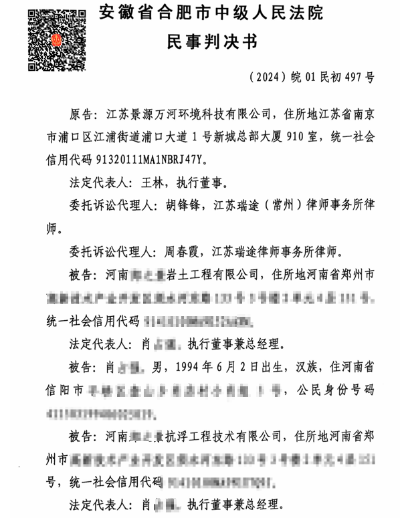
▲ First Page of the Civil Judgment (2024) Wan 01 Min Chu No. 497 of the Hefei Intermediate People’s Court of Anhui Province
II. Case Notes: Three Key Turning Points That Determined the Outcome
This was a typical “hidden works” patent infringement case. The infringing product was a variable-diameter reinforcement cage buried in the underground structure of a construction project; once construction was completed, it would be covered by concrete. The manufacture and sale of the infringing product were hidden behind multiple layers of entities, including the general contractor, subcontractor, and supplier. From the first infringement notice letter issued in August 2022 to the final ruling taking effect in September 2026, the case spanned five years and lasted more than four years. The case team fought hard battles in three areas: evidence collection, interpretation of rights, and damages.
(1) First Step in Evidence Collection: Fixing Evidence Through Administrative Adjudication to Overcome the Difficulty of Obtaining Evidence in Construction Project Infringement
Patent infringement evidence collection in construction projects naturally faces three obstacles: first, the infringing product is located within an underground structure under construction, constituting hidden works, and the evidence collection window is extremely short; second, the construction site involves layers of general contractors, subcontractors, and suppliers; third, key data such as the quantity, unit price, and profits of infringement are all in the opposing party’s hands, often leading to the dilemma in civil litigation that “the right holder cannot produce evidence and the court cannot ascertain the facts.”
In response to this dilemma, the case team determined its path: first use patent infringement administrative adjudication procedures as a preliminary measure to “fix” the facts of infringement, and then initiate civil damages claims on that basis.
In September 2022, after the case team discovered suspected infringing products at the construction site of the Cardio-Cerebrovascular Center Project of the First Affiliated Hospital of Bengbu Medical College, it filed an application for patent infringement administrative adjudication with the Bengbu Municipal Market Supervision Administration, naming the project’s general contractor and subcontractor as respondents. On September 28, 2022, the Bengbu Municipal Market Supervision Administration conducted an on-site inspection at the construction site and made an on-site inspection record. In the subsequent investigation record, the on-site person in charge of the subcontractor clearly stated that the reinforcement cages inspected on site were purchased by his company, including 1,100 units purchased from Defendant Henan XX Geotechnical Engineering Co., Ltd. at a unit price of RMB 398 per unit. This statement became the first-hand basis for subsequently determining the quantity and sales unit price of the infringement.
In July 2023, the case team separately filed another application for administrative adjudication naming Henan XX Geotechnical Engineering Co., Ltd. as the respondent. In November 2023, the Bengbu Municipal Market Supervision Administration issued the Patent Administrative Adjudication Beng Zhi Fa Cai Zi (2023) No. 4, finding that the company had supplied 1,100 units to the project in eight batches, and that the eight stamped inspection qualification certificates it submitted corroborated the 1,100 units recorded in the subcontractor’s purchase ledger, forming a complete evidence chain. The adjudication also found that the technical features of the accused infringing product included all the technical features recorded in Claims 1, 4, 6, 7, 9, 10, and 11 of the patent at issue, falling within the scope of protection of the above seven claims, and ordered it to stop manufacturing and selling the infringing products.
At the South Campus Project of Shouxian People’s Hospital in Huainan, the case team followed the same path: on August 15, 2023, the Shouxian Market Supervision Administration conducted an on-site inspection and sampling at the construction site; on November 1, 2023, the Shouxian Market Supervision Administration issued the Administrative Adjudication Huai Shou Zhi Fa Cai Zi [2023] No. 1, likewise finding that the accused infringing product fell within the scope of protection of the above seven claims and ordering the construction party to stop selling and using the infringing products. At the same time, through payment receipts, bank transfer records, and value-added tax invoices, the case team locked down that the project payment of RMB 259,000 was received and invoiced by Defendant Henan XX Anti-Floating Engineering Technology Co., Ltd., laying a key foundation for subsequently piercing through affiliated entities to pursue liability.
[Images: Some infringing products at the construction site]
Case Notes:
Administrative adjudication procedures are initiated by administrative authorities in accordance with the law for on-site inspections, investigations and inquiries, and sampling for evidence. They have the characteristics of low initiation cost, high evidence collection efficiency, and rapid fact-fixing. The two administrative adjudications and their procedural materials in this case were both adopted by the court in the subsequent civil litigation, becoming the foundational evidence for establishing infringement and determining the quantity and sales price of the infringement. For technical cases where products have already entered the construction stage and it is difficult for the right holder to collect evidence on its own, “first fixing facts through administrative adjudication, then claiming damages in civil litigation” is an enforcement path worth promoting and learning from.
(2) The Decisive Point: How to Lock in the “Sole Interpretation” When Claims Contain Clerical Errors and Ambiguities
Among the three disputed issues at first instance, the first was “how to determine the scope of protection of the patent at issue”—this was the decisive point of the entire case.
[Image: Page 32 of the first-instance judgment: The first disputed issue is “how to determine the scope of protection of the patent at issue.”]
The crux of the case was that the phrase in Claim 1, “the end of the annular hoop is provided with an annular hoop release device,” was inconsistent with the parallel technical solution in the preceding part of Claim 1, “the annular hoop is an elastic annular spiral spring hoop or flexible steel wire,” and was also inconsistent with the specific structural records in dependent Claims 3 and 4. There were textual defects and ambiguities. The defendants argued on this basis that “annular hoop” in Claim 1 could not be interpreted expansively and did not accept the patentee’s claim of a clerical error. If this defense had been established, the accused infringing product might not fall within the scope of protection, and the entire case would have been lost.
The case team’s position was that “annular hoop” in Claim 1 should be corrected to “annular spiral spring hoop” to correspond to the two parallel technical solutions listed in the patent. The normative basis and argumentation path for this position were as follows:
[Image: Page 33 of the first-instance judgment: The “sole interpretation” rule established by Article 64, Paragraph 1 of the Patent Law and Article 4 of the Interpretation (II) of the Supreme People’s Court on Several Issues Concerning the Application of Law in the Trial of Patent Infringement Dispute Cases.]
Pursuant to Article 64, Paragraph 1 of the Patent Law of the People’s Republic of China, “the scope of protection of an invention or utility model patent shall be determined by the content of its claims, and the description and drawings may be used to interpret the content of the claims,” and Article 4 of the Supreme People’s Court’s Interpretation (II) on Several Issues Concerning the Application of Law in the Trial of Patent Infringement Dispute Cases, “where there are ambiguities in grammar, text, figures, or symbols in the claims, description, and drawings, but a person of ordinary skill in the art can derive a sole interpretation by reading the claims, description, and drawings, the people’s court shall determine the matter according to that sole interpretation,” the case team focused its argument on the provable objective standard of “whether a person of ordinary skill in the art can derive a sole interpretation.”
Around this standard, the case team systematically reviewed and submitted three evidentiary threads:
Internal self-corroboration in the description. Paragraphs 0015 and 0016 of the description clearly distinguish between “the end of the spiral spring annular hoop is provided with an annular hoop release device” and “when flexible steel wire is used, a release device provided with spreading ribs and vertical ribs.” Paragraphs 0066 and 0067 further describe the specific compositions of the two release devices respectively. The two threads corroborate each other, pointing to a single answer.
Correspondence between the description’s embodiments and drawings. Paragraph 0072 of the description records that the spring fitted on the axial rod and the annular spiral spring hoop can be used simultaneously; Paragraphs 0073 and 0074 record the composition of the release device for spreading vertical ribs and ribs (spring 4-1, ring-shaped fastener 13, rib 3, pin 3-1, pin support 3-2, etc.); Paragraph 0075 records the composition of the release device at the end of the annular spiral spring hoop (steel sleeve ring 6-1, plug pin, steel tray with insertion hole 8-1, etc.), corroborating the foregoing paragraphs one by one.
Reverse exclusion based on the patent prosecution file. The prosecution file of the patent at issue shows that none of the reference documents cited in the three office actions recorded “the end of the annular spiral spring hoop is provided with an annular hoop release device,” nor did they mention that this technical feature affected novelty or inventiveness; the existing evidence also cannot prove that the reason the patent was granted was that “annular spiral spring hoop” was amended to “annular hoop.” Accordingly, it could be excluded that this feature was subject to restrictive interpretation in order to obtain authorization.
[Image: Page 35 of the first-instance judgment: The court determined the meaning of the claims in light of Paragraphs 0015, 0016, 0066, and 0067 of the description.]
The court ultimately adopted the above position and further clarified the methodology for correcting clerical errors in claims: on the one hand, patent drafting is limited by language expression and drafting and agency capabilities, and defects of imprecise wording or inaccurate expression are unavoidable; the patentee should be allowed to correct drafting errors, otherwise innovation achievements would be difficult to protect; on the other hand, correction must be limited to “a sole and definite correction conclusion that a person skilled in the art can make based on the description and drawings,” and the opportunity must not be used to expand the scope of patent protection. In this case, the court found that “the end of the annular hoop is provided with an annular hoop release device” in Claim 1 should be solely understood as “the end of the annular spiral spring hoop is provided with an annular hoop release device.”
[Image: Pages 36–37 of the first-instance judgment: The court ultimately found that Claim 1 should be given a “sole interpretation.”]
This finding directly determined that the accused infringing product fell within the scope of protection of Claims 1, 4, 6, 7, 9, 10, and 11. It can be said that without an accurate interpretation of the textual defects in the claims, there would have been no basis for winning this case; and the achievement of this interpretation depended on paragraph-by-paragraph comparison and systematic argumentation of the description, drawings, and prosecution file.
(3) Making the Cost of Infringement Higher Than the Benefit: Advancing the Application of Punitive Damages
In patent infringement cases, the application rate of punitive damages is not high—it requires satisfying both “intentional infringement” and “serious circumstances,” and requires a calculation base of the right holder’s losses, infringement profits, or patent licensing fees. In this case, the case team organized a complete evidence chain around the above elements.
[Image: Page 41 of the first-instance judgment: The court comprehensively considered factors such as the number of infringements, duration, and subjective state.]
The court ultimately found that the case met the conditions for applying punitive damages. The three facts it considered had all been fixed by the case team during the evidence presentation stage:
Objectively, there were many infringements over a long period. The defendants manufactured and sold the accused infringing products in two projects: the First Affiliated Hospital of Bengbu Medical College Project (2022) and the South Campus Project of Shouxian People’s Hospital (2023), spanning multiple years.
Subjectively, they knew of the existence of the patent right. Defendant Xiao XX, as a professional engaged in foundation anti-floating work, had purchased relevant samples from the patentee before the accused infringing acts occurred in this case, and through promotional materials provided by the patentee knew that it enjoyed the patent at issue and the market prospects of the product. Subsequently, the company of which he was the legal representative began manufacturing and selling the accused infringing products.
They did not stop infringement after receiving the infringement notice letter and after administrative investigation. In August 2022, the right holder sent an infringement notice letter to the defendants; in September 2022, the Bengbu Municipal Market Supervision Administration conducted an investigation at the project construction site; the defendants still continued the same infringing acts in a new project in 2023, subjectively seeking the continued occurrence of infringement and further expansion of the scale of infringement.
[Image: Page 42 of the first-instance judgment: The court found that the defendants did not stop infringement after receiving the infringement notice letter and after administrative investigation, and the circumstances were serious.]
In determining the amount of damages, the case team argued for applying four times punitive damages based on the actual losses of the right holder in the two projects. After review, the court held that the right holder had already received partial compensation from the construction party, and the patented technology product at issue was difficult to characterize as the unique product achieving the anti-floating effect on the market, so it was inappropriate to use the losses claimed by the right holder as the calculation base; however, it also clarified that based on the evidence in the file, the defendants’ infringement profits could be ascertained—the sales quantity confirmed by a third party in the Bengbu project was 1,100 units at a unit price of RMB 398 per unit, and in the Shouxian project the right holder proved 740 units (the defendants admitted 860 units), with unit prices between RMB 301.16 and RMB 350. Ultimately, the court comprehensively determined RMB 200,000 as the calculation base for punitive damages based on infringement profits, and calculated punitive damages at one times that amount.
[Image: Page 44 of the first-instance judgment: Using infringement profits, the court determined RMB 200,000 as the base and applied punitive damages at one times, ordering joint compensation of RMB 400,000.]
At the same time, the court supported the case team’s position on piercing through affiliated entities to pursue liability: Defendant Xiao XX was the legal representative, controlling shareholder, and actual controller of the two defendant companies, and he led and decided the infringing acts, constituting joint infringement; because he failed to prove that his personal property was independent from the company’s property, and because he was the sole shareholder of a one-person company, he should bear joint and several liability; Defendant Henan XX Anti-Floating Engineering Technology Co., Ltd. and Henan XX Geotechnical Engineering Co., Ltd. had the same business premises, the same legal representative and controlling shareholder, and collected payment for the infringing products and issued invoices in the project at issue, also constituting joint infringement and bearing joint and several liability.
III. Judgment Result
The Hefei Intermediate People’s Court ruled at first instance: Defendants Henan XX Geotechnical Engineering Co., Ltd., Henan XX Anti-Floating Engineering Technology Co., Ltd., and Xiao XX shall stop manufacturing and selling products infringing the invention patent at issue; and shall compensate the plaintiff a total of RMB 430,000 for economic losses and reasonable enforcement expenses.
[Images: Pages 44–45 of the first-instance judgment: The operative part of the judgment.]
In the second-instance proceedings, all parties separately submitted applications to withdraw their appeals to the Supreme People’s Court in September 2026. After review, the Supreme People’s Court held that the parties’ voluntary withdrawal of appeals did not harm national interests, public interests, or the lawful rights and interests of others, and did not violate legal provisions. It ruled to permit the withdrawal of appeals. The first-instance judgment took legal effect from the date of service of the ruling, and the ruling was final.
IV. Case Team
In this case, Attorneys Fengfeng Hu and Chunxia Zhou of Jiangsu Rayto and Jiangsu Rayto (Changzhou) served as authorized litigation agents, and Attorney Cheng Bao participated in handling the case. Since accepting the engagement in 2022, the case team completed all work, including evidence collection for the infringing products, applications for and participation in patent infringement administrative adjudications in two locations, applications for technical feature identification of the infringing products, first-instance filing and court hearings, second-instance response, and applications to withdraw appeals. The case spanned five years and involved administrative authorities in two locations, two levels of adjudication, and three core technical comparisons. The case team continued to invest in sorting out technical facts, arguing the interpretation of rights, and controlling the procedural rhythm, ultimately bringing the case to a conclusion with the first-instance judgment taking effect and punitive damages being approved for application.